About this site
How these pictures were made
Every photograph on this site was generated, and the rule they were made under is stricter than it looks: nothing in any frame is a thing anybody could read.
What the pictures are
Every photograph on this site was generated. No real person appears anywhere on it, and no image shows a real document: everything that looks like a certificate, a stamp or a register entry is invented, unreadable at any size, and belongs to nobody. There is a page about how they were made and why that decision was taken.
That is the ordinary disclosure, and on most sites it would be the whole page. This trade makes it a harder problem than usual, because the product here is text. Photograph a translation office honestly and the frame fills with documents, certificates, stamps, seals, screens, letterheads and a wall of dictionaries — every one of them a lettering surface, and most of them surfaces whose entire purpose is to be read.
An image model will happily produce all of that, and what it writes on any of it is invented. Not a language, not a real form, not a real seal: a plausible-looking scribble that a reader assumes is a document. On a site about translation that is the worst thing in the world to publish, and it cannot be fixed by asking for it not to happen — there is no way to tell one of these models what to leave out. A thing that invites lettering has to leave the frame.
So the rule is not about text. It is about reading.
Nothing in any frame on this site is a thing anybody could read. That is a stronger claim than avoiding text and, unusually, an easier one to hold, because it turns into six structural decisions rather than six instructions.
-
Every document is blank
Not blurred, not shot at an angle, not cropped so the words fall outside the frame — blank. Paper appears on this site as paper: stacks seen edge on, sheets with a raking light across the fibre, a security watermark that is an abstract wavy texture and nothing else. There is no printed document anywhere on this site, and the alt text on every image says so.
-
Every seal and every stamp is smooth
A blind-embossed circle with nothing inside it. A pool of wax with no impression in it. An embosser whose plate is plain metal. The deformation without the mark. This is the one that took the most thinking about, because a seal is the most photogenic object in this trade and a seal is by definition an inscription.
-
Every screen is off
Black and blank. A screen showing an interface is a screen showing words, and a screen showing words in a generated image is a screen showing invented words that a visitor will read as real software.
-
The books are texture
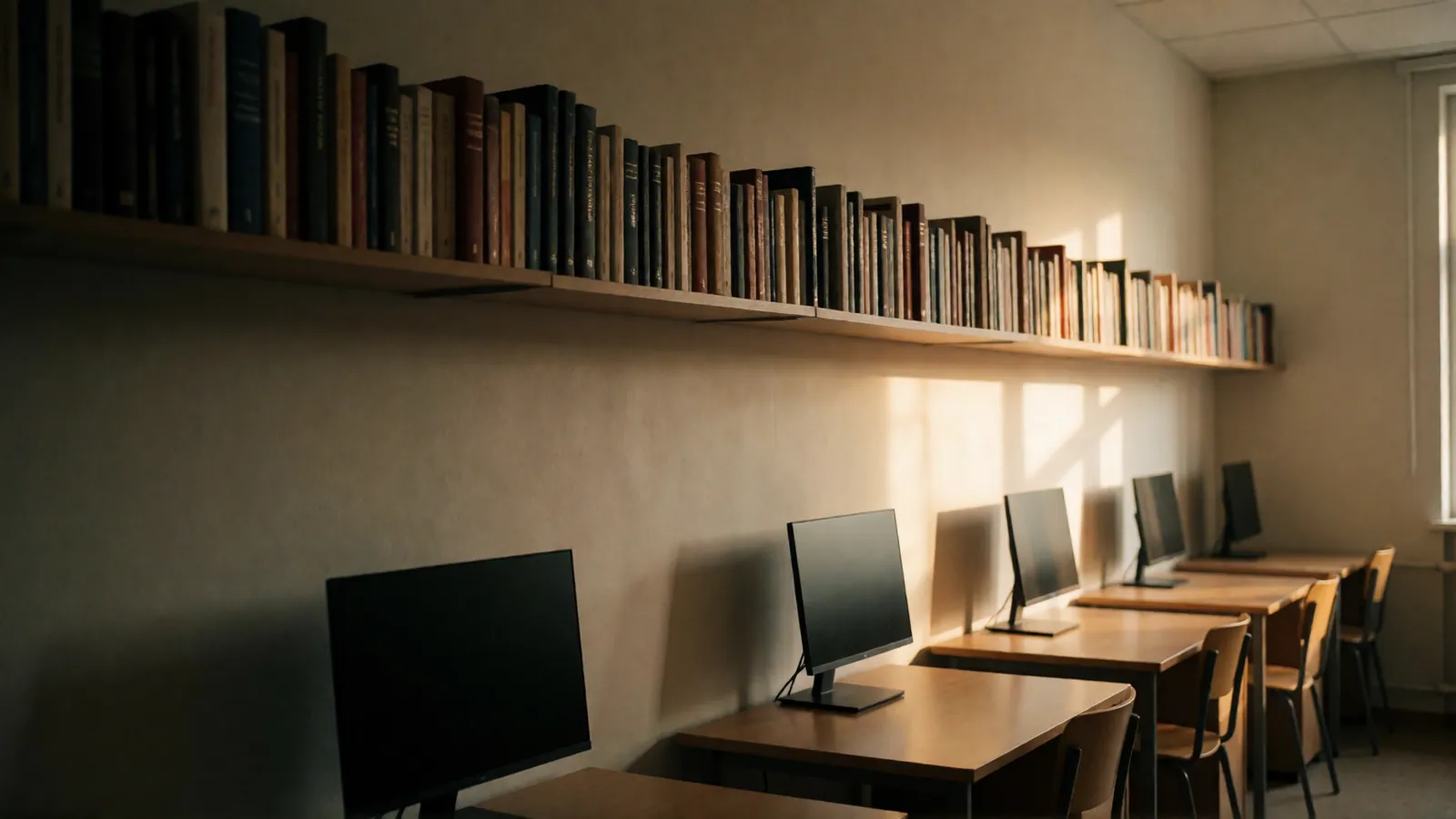
A translator's office has a wall of dictionaries, and a dictionary is a spine with a title on it. The shelf is photographed at a sharp oblique angle in deep shadow, so the spines read as rhythm rather than as titles. Nothing on it is legible and nothing on it is meant to be — the photograph at the top of this page is that shot.
-
No flag, no map, no shopfront, no badge, no letterhead
The flags are the trap peculiar to this trade. Twenty-four language pages are exactly where a designer reaches for a row of little flags, and a flag is the graphic mark of a state — rendered wrongly by these models, and not something an invented company has any business printing. The language pages share one photograph of blank paper in twenty-four tints instead, which is also the better picture: this work is about the paper, not the passport.
-
No wall behind a portrait
A portrait prompted with no framed certificates behind the subject came back, on an earlier build in this series, with a framed document over the subject's shoulder. Naming a thing in the negative does not remove it. So three of the five portraits here are shot against a blown-out window and the other two against a wall thrown so far out of focus that there is no surface for a frame to hang on. The wall is not instructed away; it is not in the picture.
Who is in them
Five portraits, and that is the whole of it. No client, no official, no child, and nobody holding a document — a person holding a page is a person presenting a text surface to the camera at the most legible angle available. Every other room on this site is empty, and the alt text on every image records what is actually in the frame, because an image can be re-rendered and the words underneath it left untouched.
One that had to be done again
The first attempt at the birth-certificate photograph carried a stray character from another alphabet inside an otherwise English instruction — a slip while a batch was being written. On any other site that is a typo. On this one it was an instruction for a picture of a document, containing a glyph, inside a set whose entire purpose is that no glyph appears anywhere. It was made again from scratch rather than picked over, and it is written down here because the failure it would have produced is exactly the one all of the above exists to prevent.
Why any of this is on a public page
Because a visitor is entitled to know which parts of a website are photographs of a real place and which are not, and because the alternative — a line in a footer nobody reads — is the version that technically told you. The same principle runs through the rest of the site: the telephone number reaches nobody and says so, the estimate is arithmetic and says so, and nobody here is described as holding a credential, because a credential is the one thing a demonstration must never invent.
About the photographs. Every photograph on this site was generated. No real person appears anywhere on it, and no image shows a real document: everything that looks like a certificate, a stamp or a register entry is invented, unreadable at any size, and belongs to nobody. There is a page about how they were made and why that decision was taken.
Send us the document
A photograph is enough to quote from. Or work out the figure yourself first — the estimator shows its arithmetic rather than only its answer.